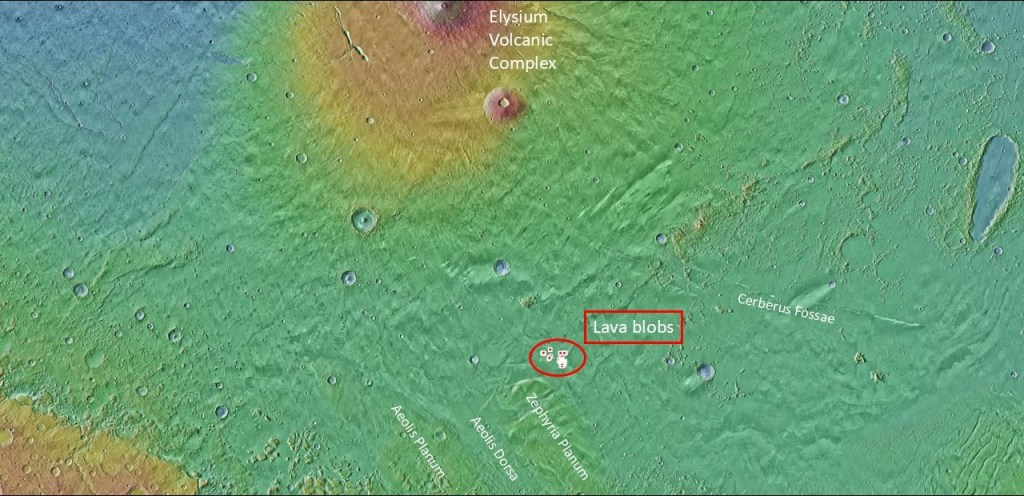
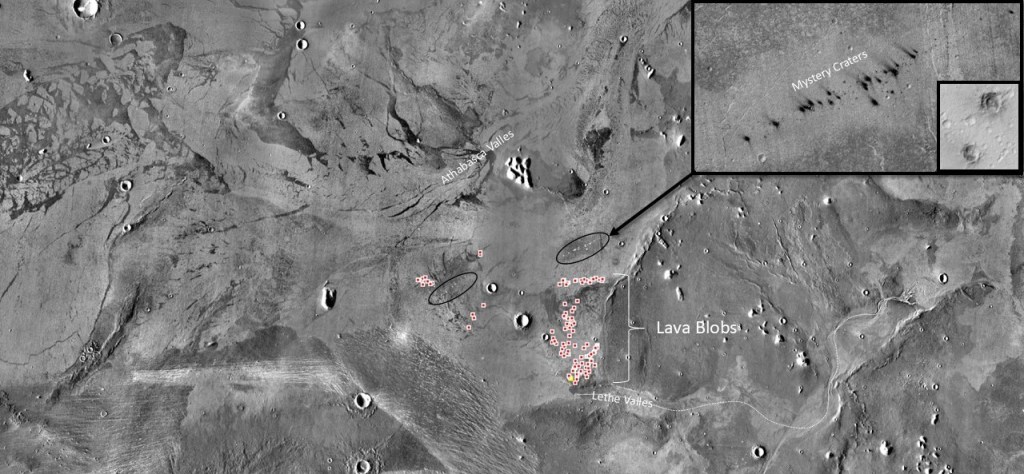
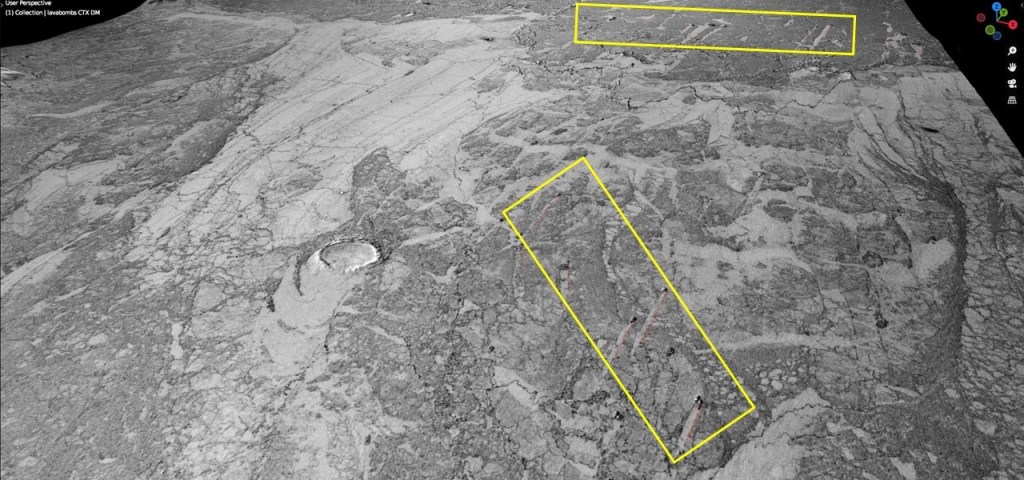
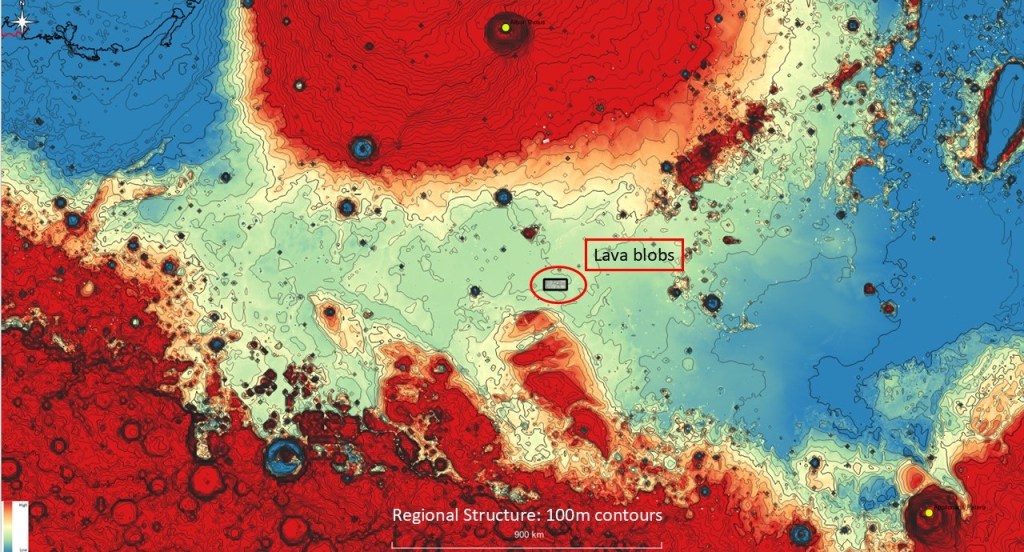
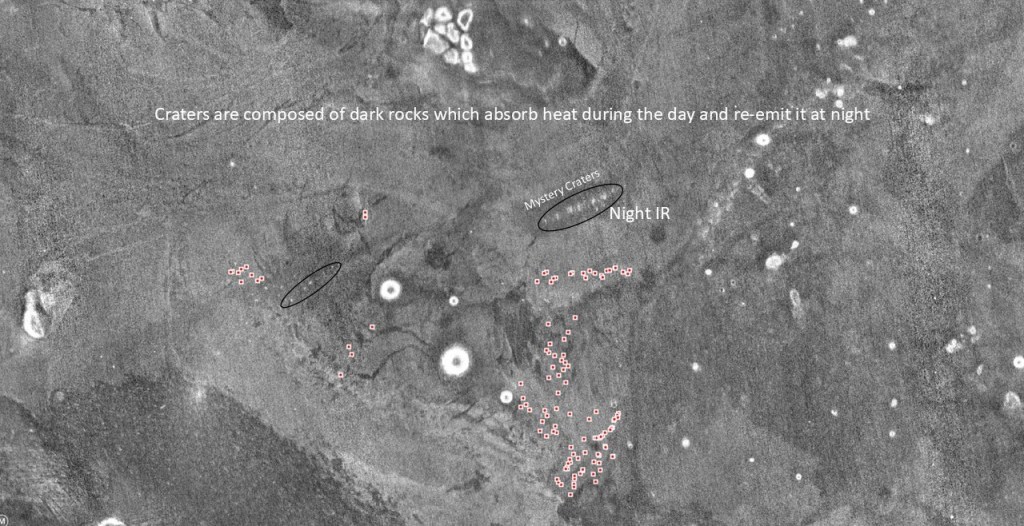
On the flank of the Elysium Volcanic Complex, amidst multi-directional lava flows, an enigmatic collection of lava blobs can be seen, seemingly plowing through fresh lava sheets and leaving bare tracks in their wake. Their location is shown on the following slide as clusters of squares, between Athabasca Valles and Lethe Vallis. A linear concentration of craters is also seen in the vicinity.
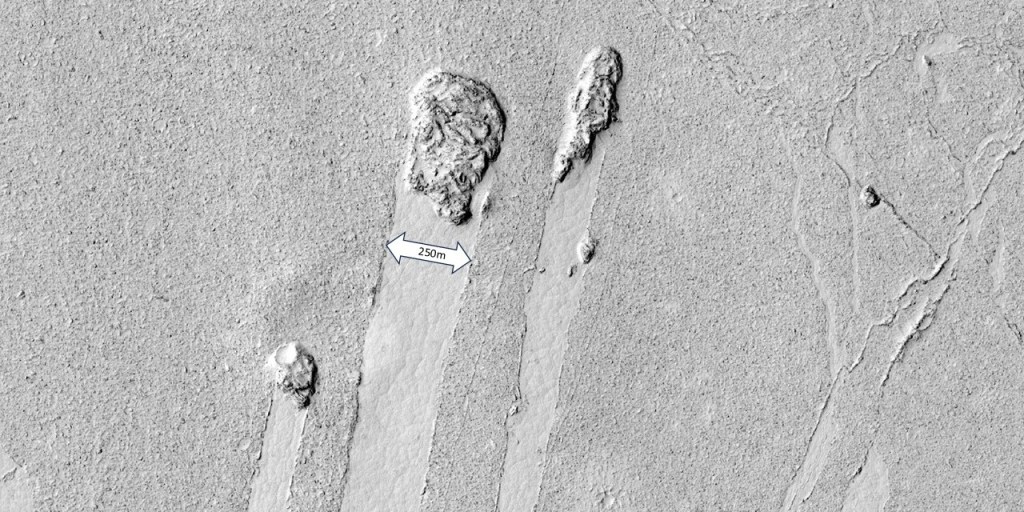
A close-up view of the blobs show them to be of the same consistency as the surrounding lava, with the relative motion revealed by a convex front. The question remains, whose motion? The blobs moving through freshly deposited lava, or fresh lava moving around the blobs?
The next few slides illustrate groups of the blob/trail complexes:
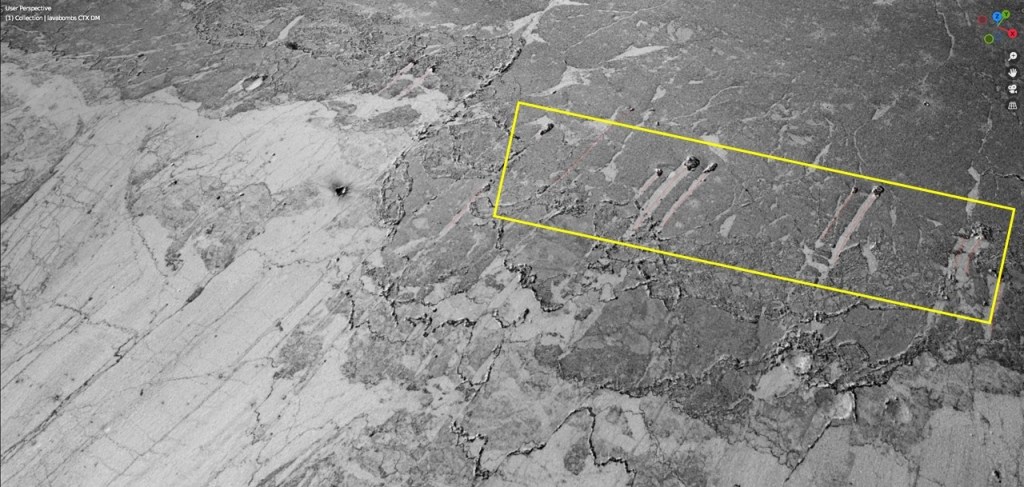
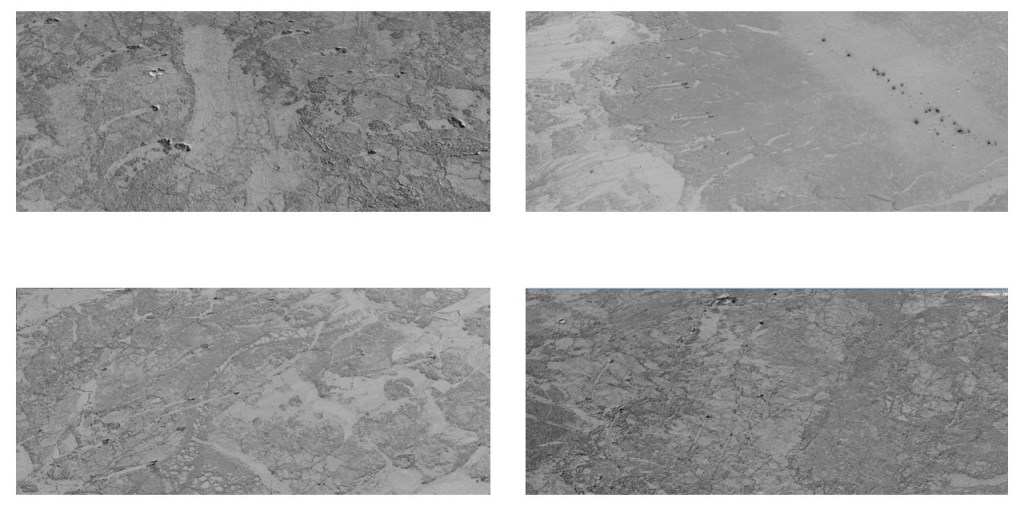
So what is moving, the blobs or the lava? One possibility is that the blobs were large lava bombs which were expelled by a violent initial eruption, anchored in place, then inundated by lava sheets which parted around them, leaving bare ground in their wake. Another, that some boulders plowed through freshly laid-down lava, building up and accreting it in front like a snow-plow.
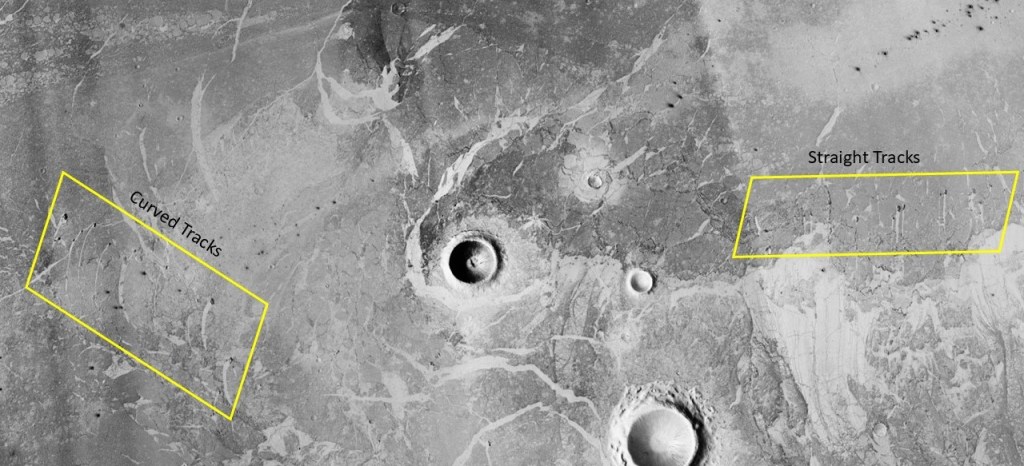
Throwing us the proverbial curve-ball, we see curved trails as well, which now introduces more complications: topography, wind, or some kind of coriolis effect.
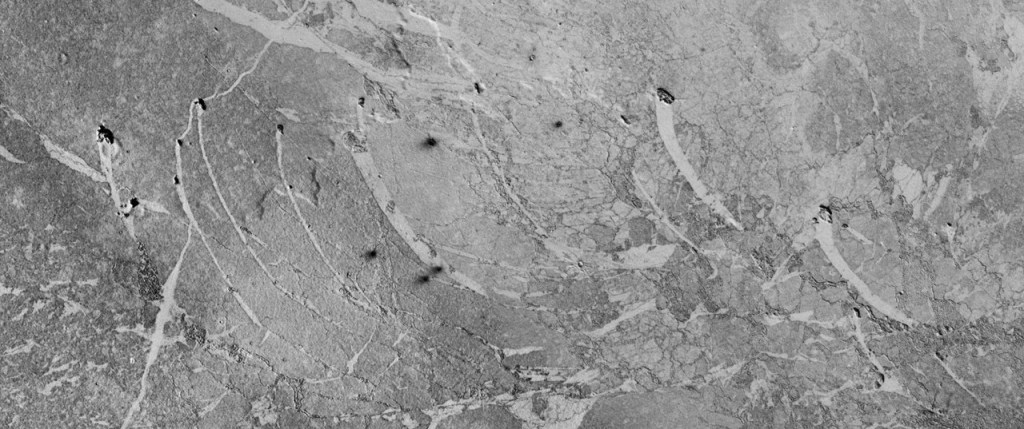
The coriolis effect can probably be eliminated, as we have (relatively) adjacent curved and straight tracks:
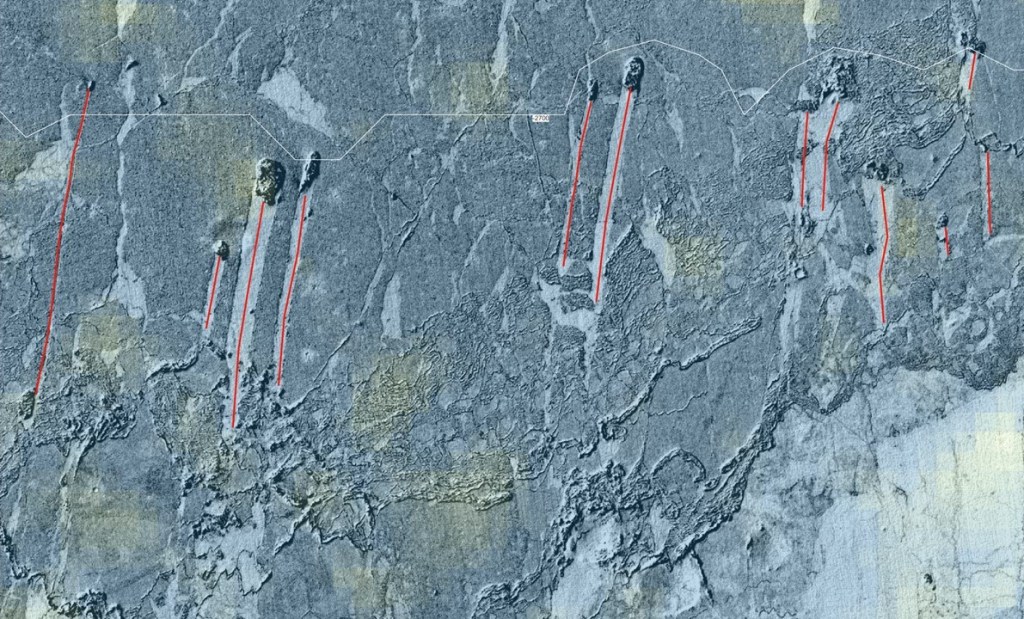
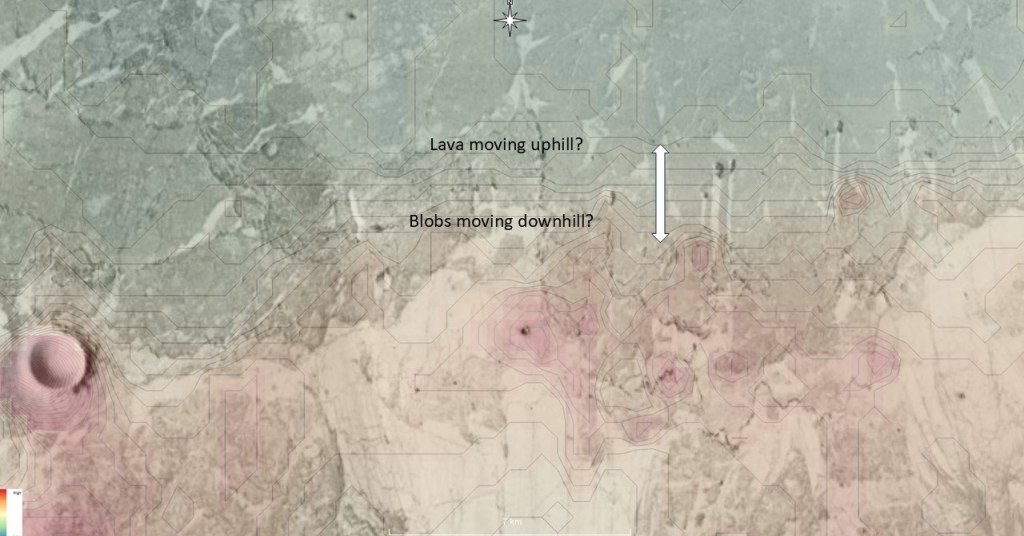
So what about topography? (red high-blue low, 1 meter contour interval) on the next slide is an argument for lava rather than blob movement, forgetting about the curved track for the moment.
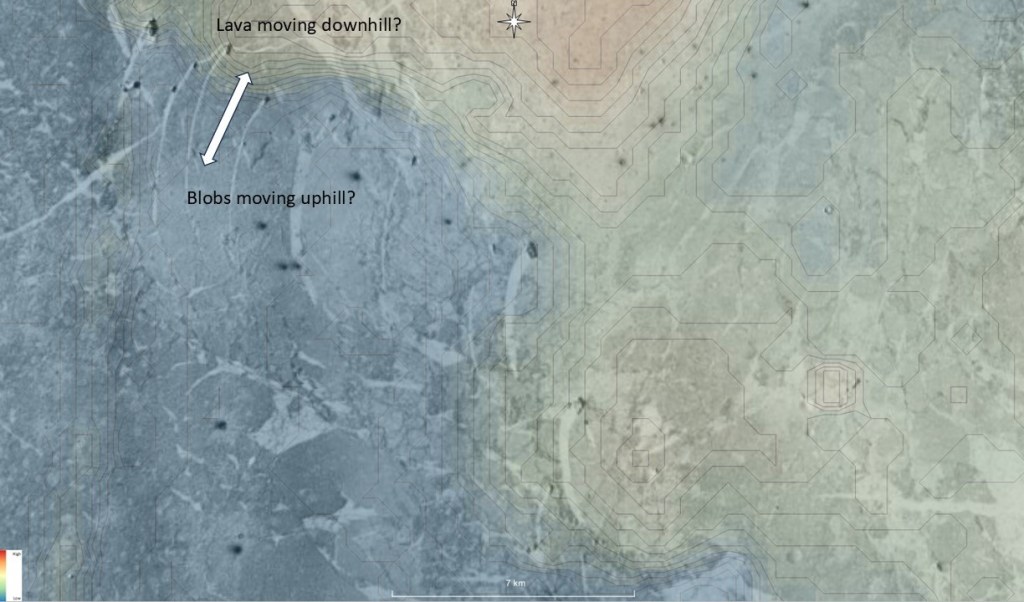
The next picture supports the blob (downhill) movement:
The topography might also have been effected by subsurface magma withdrawal as a result of, or post-dating, the lava flows, and thus may be irrelevant.
The idea of wind effects seems kind of far-fetched, considering the current thin atmosphere, but it might have been quite different in the Amazonian, maybe with a much thicker atmosphere and hurricane-force winds. The illustration below shows tracks made by sailing rocks in Death Valley. This required some admittedly special circumstances, such as a wet substrate, shallow water, a thin layer of floating pancake ice, and enough wind to push the ice against the rocks (weighing up to hundreds of kilograms). The tracks clearly show changes in wind direction.
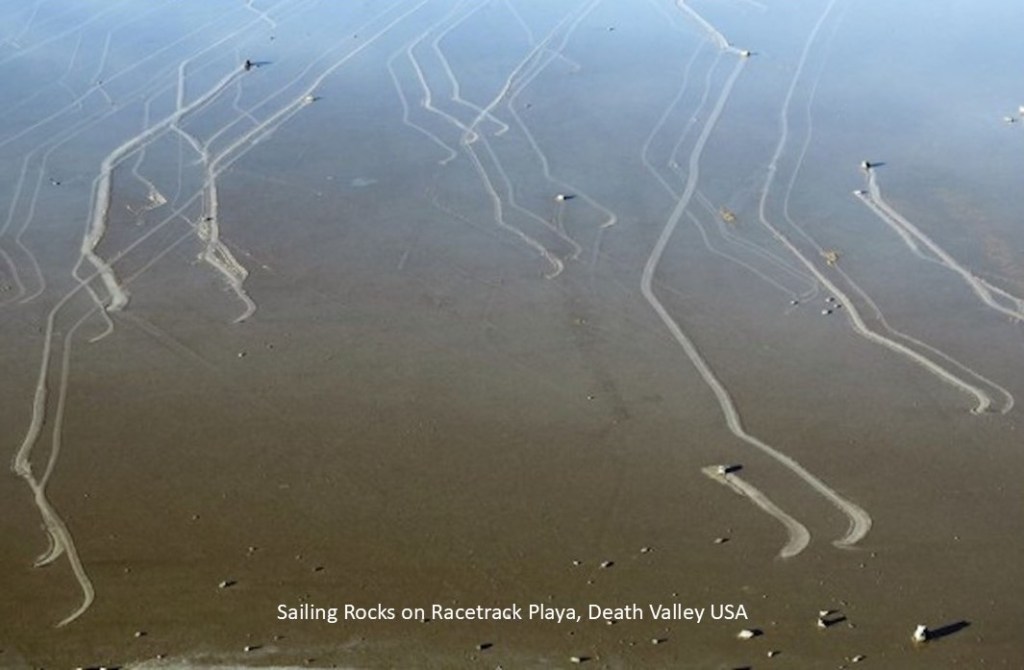
It’s still hard to imagine anything plowing through thick, viscous lava, so there may still be other contributing factors (earth quakes?) In any event, the jury’s still out on the lava tracks question.
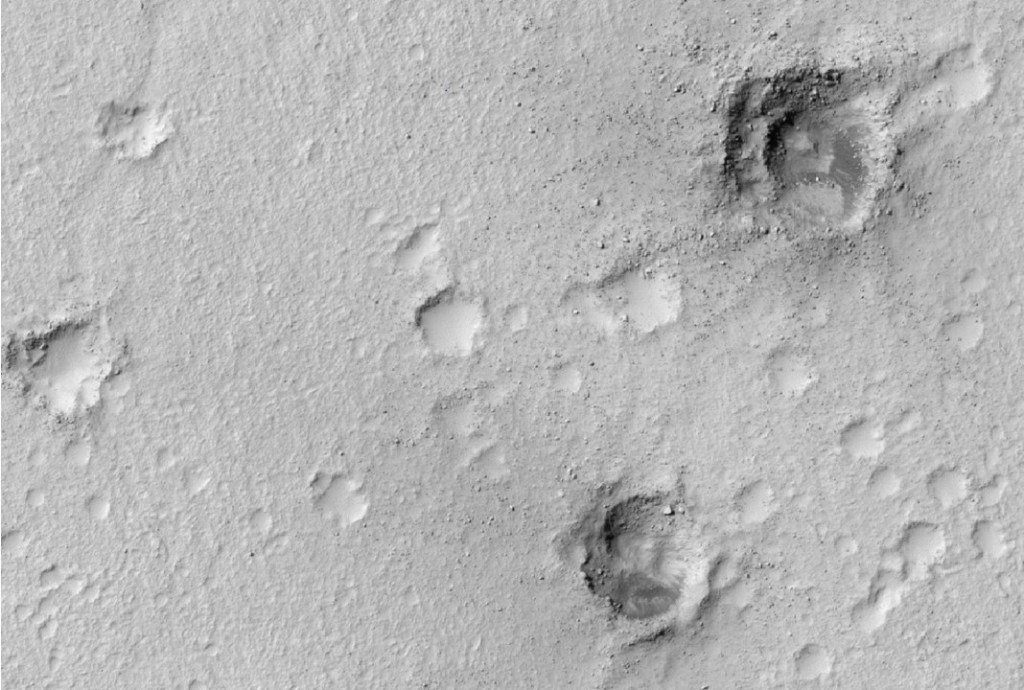
That leaves the remaining mystery, the linear alignment of craters. My guess is that they are aligned along a regional fault and are out-gassing volcanic gases, since they bring dark material to the surface (light on night infrared)
That’s it for now
 Mars Geomorphology